Your next company vehicle: would electric actually work?
6 min read · 13 October 2026. A cheaper lease doesn't mean a cheaper vehicle. Discover what the monthly payment leaves out.
A company car or van is coming up for renewal. There are electric alternatives on the shortlist. The real question is whether switching makes financial sense, and whether the replacement would still do the job.
That is more useful than asking whether the whole fleet should go electric. A replacement decision has to work for one vehicle, one driver and one pattern of use. Build a convincing case there, then repeat it across the vehicles approaching renewal.
We have enhanced the Orbis EV cost calculator to help you start that assessment.
"I have run this decision at every scale, from a single van to a 35,000-vehicle fleet, across 40 years and as chair of the BVRLA Leasing Broker Committee. The mistake is always the same: judging the car on the monthly rental. The rental is the smallest part of what it costs you."
Alan Carreras, founder, OrbisIO
Start with the vehicle you need to replace
Enter a registration or select the vehicle manually, then describe its mileage and where it could charge. You can also set requirements such as seven seats, load space, four-wheel drive or towing.
The calculator estimates the difference over your chosen business contract-hire term and identifies electric alternatives that could cover its regular journeys. Your initial result is available without creating an account.
A cheaper lease is not a cheaper vehicle
The familiar comparison is two lease prices, side by side. It is useful, and it leaves out most of the cost.
A higher rental can be the cheaper vehicle once the full contract is counted. A lower rental can lose its advantage the moment the vehicle starts covering miles. The headline difference only means something against a consistent contract length, mileage and set of assumptions.
The Orbis calculation includes the lease, maintenance, energy, employer National Insurance on the benefit in kind, and vehicle excise duty, including the per-mile charge on electric vehicles (eVED) from April 2028. Home-charger installation is included where the electric vehicle would charge at home. Insurance is excluded, because business contract hire does not include it. The result is an estimate, not a quotation.
Two figures explain why the monthly payment misleads. An electric company car is taxed on 4% of its list price as benefit in kind in 2026/27. A petrol or diesel car emitting 95g/km or more is taxed on 25% or higher. Charging at home costs 7p a mile on HMRC's advisory electric rate from 1 September 2026, against 15p a mile at a public charger, and rapid chargers cost more again. Both figures land outside the rental line, and both can decide the result.
A live example: a 3 Series Touring, over three years
This is a result from the live calculator on 13 October 2026, for a BMW 3 Series Touring 320i M Sport Pro on business contract hire over three years, charging 80% at home and 20% at public chargers on HMRC's advisory electric rates and the DESNZ pump price of the week.
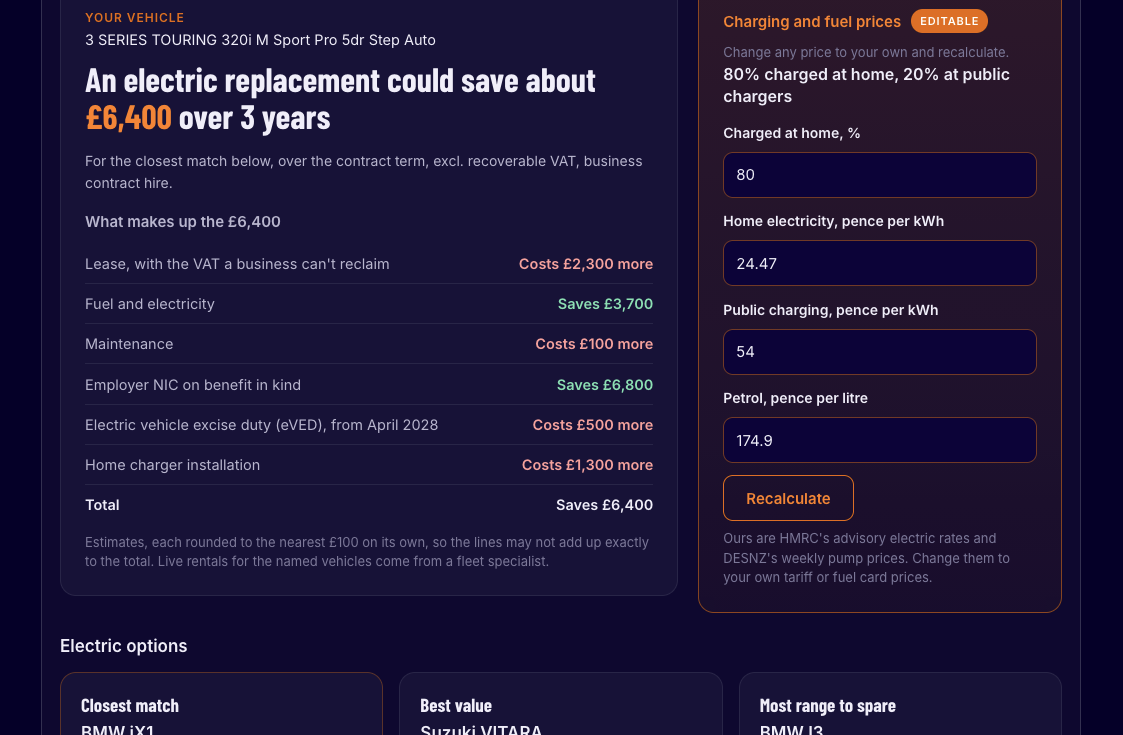
| What makes up the difference | Electric, against the petrol car |
|---|---|
| Lease, with the VAT a business cannot reclaim | Costs £2,300 more |
| Fuel and electricity | Saves £3,700 |
| Maintenance | Costs £100 more |
| Employer NIC on benefit in kind | Saves £6,800 |
| Electric vehicle excise duty, from April 2028 | Costs £500 more |
| Home charger installation | Costs £1,300 more |
| Total | Saves about £6,400 |
Both cars are priced like for like: the same business contract hire terms, the same three-year term, the same mileage and the same pricing source, with insurance excluded on both. So the lease line is a fair comparison, not a petrol car flattered by a different finance product or a shorter term.
Read the lease line first. The electric car costs £2,300 more to lease over the term, and it still comes out about £6,400 cheaper. On the rental alone the petrol car wins. The two lines that overturn it are the energy saving and the employer National Insurance saving, and neither appears in a lease comparison.
The employer National Insurance line is the business's own charge, not the driver's. An employer pays Class 1A National Insurance at 15% of the taxable value of the car benefit, and that value is 4% of list price for the electric car against more than a third of list price for a petrol car with the 320i's emissions. The driver's income tax on the same benefit falls in the same direction. That is a separate saving, to the person driving the car, and it is not counted in the £6,400, which is employer cost only.
Read the home charger line next. It is a real cost of £1,300, and it only exists because this driver can charge at home. Take that away and the whole energy line is priced at the public rate instead, which is the sensitivity the next section is about. Each line is rounded to the nearest £100 on its own, so they do not add exactly to the total.
Test the charging plan you can actually deliver
Before you accept a favourable result, ask where the vehicle will charge in an ordinary working week.
Does the driver have reliable access at home? Is depot charging available when the vehicle returns? How often would the working day need a public charging stop?
These are operational questions as much as financial ones. A charging plan that looks good on paper still has to fit the driver's week.
The calculator lets you change the charging mix, the electricity prices and the pump price, then recalculate. Use it to test your intended arrangement and a less favourable case. If the conclusion changes sharply, you have found something to resolve before you order.
Check the demanding days
Annual mileage tells you how far a vehicle travels. It does not tell you how that mileage falls across the year.
Think about the longest regular working day, the journeys that cannot be rearranged, and the equipment or passengers the vehicle must carry. A good shortlist survives those questions. It is easier to investigate a constraint during procurement than to work around it every week after delivery.
The paper case is the start. Real data is the finish.
A calculator answers one question: would this work on the numbers you expect. It cannot tell you what the vehicle then does in use.
That gap is where assumptions cost money. On one live UK fleet, Orbis read a Volkswagen Tiguan plug-in hybrid returning 46.9mpg against a manufacturer figure of 287.2mpg. The battery sat depleted 81% of the time across 649 readings, because the driver rarely plugged in. The paper case looked fine. The vehicle did not deliver it. We wrote that case up in the 287 vs 65 mpg PHEV story.
Use the calculator to choose the vehicle. Once it is on the road, the Orbis platform reads the vehicle's own data and shows whether the case you built is actually holding.
Turn the result into a better decision
Use the estimate to structure the next conversation with your driver, finance team or leasing supplier:
- Which assumptions reflect our actual use?
- What happens if charging access changes?
- Does the proposed vehicle meet the operational requirements?
- What still needs confirming in a live quotation?
An attractive saving is a reason to investigate further. A marginal result is useful too. It tells you where the decision is sensitive and what you still need to confirm.
For the tax side of the decision, our company car tax calculator gives the benefit-in-kind trajectory to 2029/30, and the full cost of running an EV fleet covers the same arithmetic at fleet scale. From April 2027 the company-car figure also has to be right every pay run, which is the subject of our note on mandatory payrolling.
Start with the next vehicle due for replacement. Enter its registration, its mileage and where it could charge, and see the estimated difference over the contract, with the assumptions behind it.
Try the Orbis EV cost calculator →This article is for general information only and is not tax or financial advice. The tax rates and HMRC advisory rates quoted are those published at the date of this article. Calculator results are estimates from the information you give and the assumptions shown with each result, not a quotation.
Frequently asked questions
Is an electric company car cheaper than a petrol one?
Sometimes, and the monthly lease will not tell you. The answer depends on mileage, charging access and tax over the full contract. Compare the whole cost per vehicle, not the rental.
What does the Orbis EV cost calculator include?
The lease, maintenance, energy, employer National Insurance on the benefit in kind, and vehicle excise duty, including the per-mile charge on electric vehicles (eVED) from April 2028. Home-charger installation is included where the electric vehicle would charge at home. Insurance is excluded. The result is an estimate, not a quotation.
Do I need home charging to run an electric company car?
Not always, but it changes the result. Home charging costs 7p a mile on HMRC's advisory electric rate from 1 September 2026, against 15p a mile at a public charger. Test your real charging mix in the calculator before you decide.
Does a lower monthly lease mean a cheaper vehicle overall?
No. A lower rental can lose its advantage once the vehicle covers miles, and a higher rental can be cheaper across the contract. Judge the full cost over a consistent term.
Can I compare a specific vehicle?
Yes. Enter a registration or select the vehicle manually, add its mileage and where it could charge, and set requirements such as seven seats, load space, four-wheel drive or towing.